
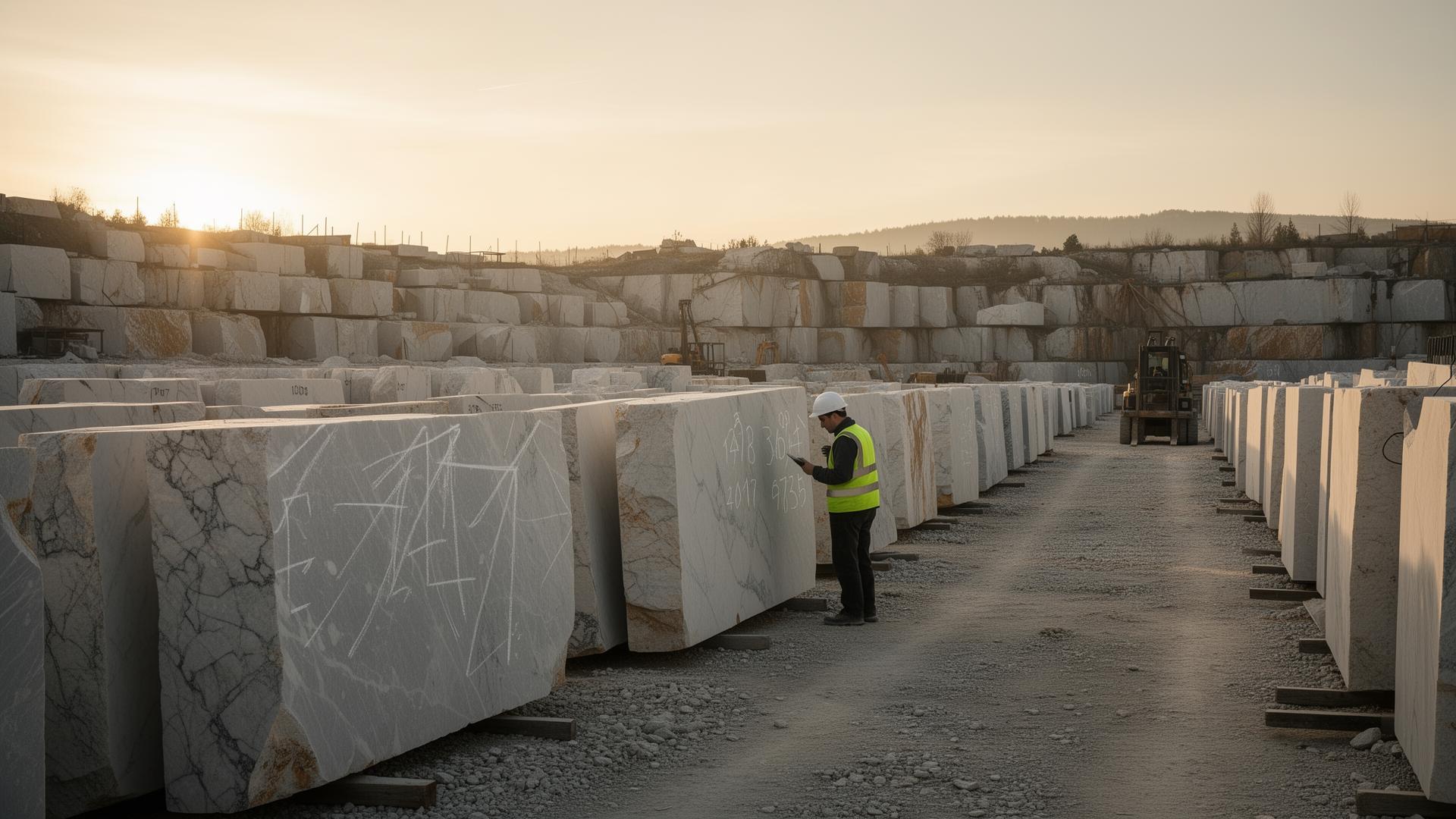
Natural stone is a finite material. Every block lifted from a quarry represents geological time, energy spent in extraction and processing, and freight miles across oceans. The honest conversation in our industry is not about labelling stone as 'eco-friendly' — it is about specifying, inspecting and using each slab well enough that less of it ends up as offcut, rejected bundle or container-damaged loss.
This guide is written for the architects, designers, fabricators and importers who actually move stone from quarry to project. It sets out the selection, inspection and procurement decisions that reduce avoidable waste across a job — and the documentation that lets you defend those decisions to clients, contractors and certifying bodies.
"Responsible sourcing in stone is mostly about better selection earlier in the chain. Most waste is decided at the block, not at the saw."
What 'Responsible Sourcing' Actually Means in Natural Stone
Natural stone is not a manufactured product. It cannot be recycled back into a slab, and most quarry waste — saw fines, offcuts, rejected blocks — is downcycled into aggregate, terrazzo chip or fill, or stockpiled on site. Calling a quarry 'zero-waste' or a stone 'recycled' is rarely accurate. The honest positioning is narrower and more useful:
Responsible sourcing means choosing materials and suppliers that align with the project's design intent, durability requirements and documentation needs — and managing the chain so that each block extracted produces the maximum usable yield for the project it was selected for.
Where Avoidable Waste Actually Comes From
Across the projects we coordinate between Brazil, Italy, Iran, Turkey and China, the same handful of decisions drive the majority of avoidable loss. None of them are quarry-side problems alone; most of them are specification and coordination problems that surface late.
1. Specifying a stone the project cannot reasonably get. Naming a material with no available block large enough for the waterfall island, or a colour range narrower than any current bundle, forces fabricators to reject slab after slab until the spec is quietly relaxed on site.
2. Approving on small samples. A 100 × 100 mm tile or a single A4 photo cannot represent the movement of a 3.2 m slab. When the full slab arrives and reads differently, the rejection rate climbs and the rejected slabs rarely find a second home in time.
3. Late shop drawings. When cutting layouts are finalised after slabs are already on the cutting floor, yield drops — the slab was not selected for that layout, and offcuts grow.
4. Container damage from poor crating. A single A-frame loaded without proper bracing can crack four to six slabs in transit. Most of that loss is preventable at the loading dock, not at destination.
5. Treating offcuts as scrap by default. Large offcuts from countertop runs are routinely thrown away when they could serve as splashbacks, shelves, sample plates or sister projects in the same fabricator's queue.
Selection: The Decision That Matters Most
Block-level and bundle-level selection is the single highest-leverage point in the chain. A block chosen well at the quarry can deliver eight to ten matched slabs for a feature wall; the same stone chosen poorly delivers two usable slabs and a stack of off-grain rejects.
On significant projects, we recommend three discipline-level commitments before any block is cut: a written colour and movement range with photographs of acceptable extremes; a confirmed end-use map (which elevations need bookmatch, which can tolerate random); and a named approver — one person whose sign-off is binding for both client and fabricator.
These three documents prevent the most expensive form of waste in stone: a fully-cut slab that no one wants to install.
Inspection: Catching Problems Before They Ship
A slab inspected at the polishing factory in Shuitou, Verona or Cachoeiro is cheap to reject. The same slab inspected at the fabricator's yard after shipping is expensive, and after fabrication has begun it is effectively unrecoverable. Push inspection as far upstream as the project allows.
A defensible pre-shipment inspection records: full-slab photographs front and back under controlled light; bundle layout with slab numbers visible; close-ups of any fissures, resin lines or repaired zones; measured thickness at multiple points; and a short video of each slab tilted under raking light to expose surface defects the camera flattens. This record is what allows damage claims and selection disputes to be resolved by evidence rather than argument.
"Every rejected slab caught at the factory is a slab not shipped, not landed, not stored, not handled twice. The cheapest waste is the waste that never leaves origin."
Using In-Stock Inventory Before Committing New Blocks
On smaller scopes — vanities, fireplaces, single islands, hotel guestroom rollouts — a slab already at port or on a fabricator's floor is almost always the more responsible choice than a fresh block extraction. The material is already cut, already shipped, already standing in a rack waiting for a project.
Specifying against live inventory also shortens the schedule and removes most of the surprises that show up when committing to unseen material. Even on large projects, sister scopes (back-of-house, secondary bathrooms, sample plates for the design team) can frequently be filled from existing stock rather than added to the new-block order.
Specification Habits That Reduce Avoidable Waste
Specify a tolerance range, not a single ideal slab. Naming a target plus an acceptable variation gives the fabricator room to use the bundle without rejecting slabs that are good stone in a slightly different register.
Specify finishes the stone actually wears well. Heavy honing on a dense quartzite produces beautiful slabs and accelerated visible wear; specifying a finish appropriate to the material extends the surface's first life and reduces the chance of premature replacement.
Specify standard slab thicknesses unless the detail requires otherwise. Custom thickness orders extract the same block but yield fewer slabs, increasing material consumption per square metre delivered.
Plan offcut destinations before cutting. Identify in advance which secondary scopes can absorb large offcuts — shelves, splashbacks, threshold pieces, sample stock — and brief the fabricator to set them aside rather than dispose of them.
Documentation That Makes the Story Verifiable
Responsible sourcing claims hold up only when there is a paper trail. The minimum chain for a project that will be presented to clients, certifiers or press: quarry name and country of origin, block number, slab numbers within the bundle, pre-shipment inspection photographs, commercial invoice, bill of lading, and the fabricator's cut layout reconciled to the slab map.
This record is unremarkable to produce when it is built turn by turn through the project. It is almost impossible to reconstruct after the fact. Build it from the first block.
Longevity: The Most Honest Sustainability Argument
Natural stone, specified and installed well, lasts decades — often the full life of the building. The most defensible environmental argument for stone is not about the quarry; it is about the floor, the wall, the countertop that does not need to be replaced in fifteen years. Selecting a material that suits its use case, detailing it properly, and protecting it through fabrication and installation is what makes that lifespan real.
Conversely, a beautiful but mis-specified stone — soft marble on a high-traffic floor, reactive surface on a working kitchen — fails early, gets ripped out, and the embodied energy of its extraction is written off. Avoiding that outcome is the single most useful thing a specifier can do.
A Short Checklist for the Next Project
Before issuing the material schedule: confirm the named stone is currently available in the sizes and quantities the project needs. Before approving: review full-slab photography, not samples, with one named approver. Before cutting: lock the shop drawings and the slab-to-elevation map. Before shipping: complete a documented pre-shipment inspection. Before disposing of offcuts: ask whether a sister scope can use them.
Frequently Asked Questions
Is natural stone a sustainable material? It is a durable, long-lived material with real extraction and freight impacts. Used well — specified to suit, installed to last, and not replaced prematurely — it compares favourably with shorter-lived surfaces. It is not accurate to describe natural stone as carbon-neutral, recycled or zero-waste without specific, audited project data.
What documentation should I request from a stone supplier? At minimum: country and quarry of origin, block and slab numbers, pre-shipment inspection photographs, commercial invoice and bill of lading. For larger projects, request the cut layout and the slab-to-elevation map reconciled to the bundle.
How can I reduce waste on a stone fabrication job? Approve on full slabs not samples, lock shop drawings before cutting, name one binding approver, plan offcut destinations before cutting begins, and inspect pre-shipment so rejected slabs never leave origin.
Is it better to use existing stock or order new blocks? For smaller scopes and sister scopes within larger projects, using slabs already at port or on the fabricator's floor is generally the more responsible choice — the material is already extracted, cut and shipped. New block orders make sense when the project's scale, format or matching requirements exceed what existing inventory can serve.
What is the difference between honest sustainability claims and greenwashing in stone? Honest claims are specific, qualified and verifiable: 'this stone was quarried in X, transported by Y, and selected with Z documentation.' Greenwashing tends to use absolute language — eco-friendly, carbon-neutral, recycled — without project-level evidence. When in doubt, prefer the narrower, evidence-backed statement.
Nick Cheng
Stone sourcing specialist with a focus on large-format marble, onyx and quartzite for architectural projects. Operates between China's processing hubs and quarries in Italy, Brazil, Iran and Turkey.